Calcium accumulation at the root surface
I was discussing saturated paste test results and made an offhand comment about the ease of using saturated paste data to demonstrate how calcium (Ca) is so abundant in the soil that it accumulates around the roots.
Here’s an example.
Calcium in the soil water
Typical soil Ca by a Mehlich 3 test is about 580 ppm. That will be about 80 ppm on a saturated paste. Actual soil solution Ca will be higher, because a saturated paste is a dilution of soil solution.1 For this example, we can use 80 ppm for a Ca concentration in soil solution. For every liter of soil water, there will be 80 mg of dissolved Ca.
Soil water use
Grass water use can be estimated by evapotranspiration (ET). Let’s say we have a month of 30 days, and we can let the average ET be 4 mm per day (0.16 inches). That’s 4 L of water use per square meter per day, and each liter has 80 mg of Ca. The water used by the grass is bringing Ca to the root surface at a rate of 320 mg per day, or 9.6 g per 30 days.
Grass Ca use
Let’s assume the grass is growing really fast. Let’s say the growth potential is 100% for 30 consecutive days and we grow the grass at a GvX of 100 for those 30 days. That means we will harvest 600 mL m-2 of clipping volume over 30 days, and those clippings have an estimated dry mass of 38 grams. If this is bentgrass,2 we expect 0.58% Ca in the dried clippings, so those 38 grams of clippings will contain 0.22 grams of Ca.
44 times more Ca delivered by mass flow than used by the grass
We have 9.6 grams of Ca delivered by mass flow to the roots, simply through normal evapotranspiration. Over the same time period that 9.6 grams of Ca are arriving to the root surface, the grass—even though we use a GvX of 100 at 100% GP3—only uses (loses) 0.22 grams of Ca. That’s 43.6 times more Ca arriving to the root surface in the soil water than is used by the grass.4
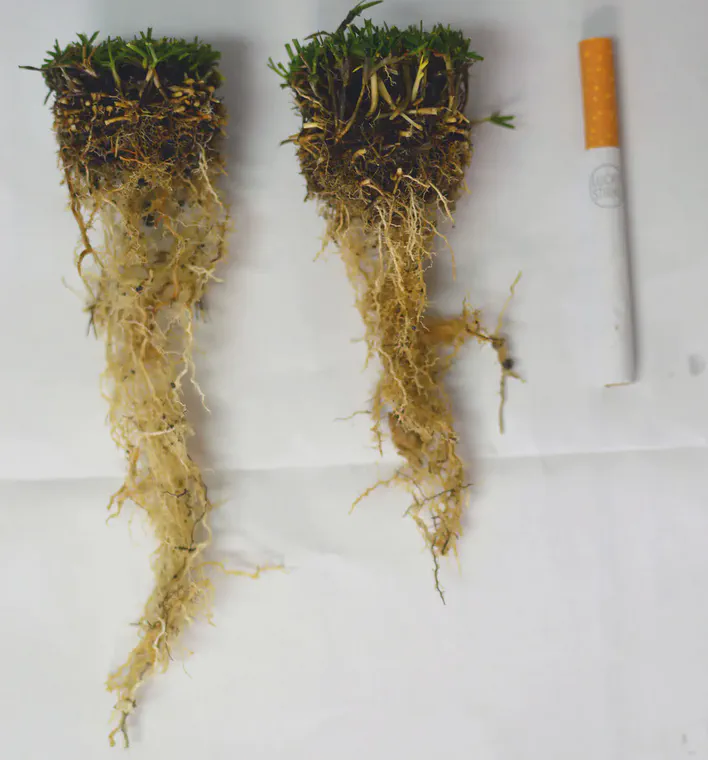
And that’s why Ca accumulates at root surfaces.
There are also relatively more monovalent cations in a more dilute solution; in soil solution there will be more Ca and Mg than what a saturated paste test shows. ↩︎
See my GCSAA conference seminars and translation guide for these values as of February 2026. ↩︎
A GP of 100% for an entire month is pretty rare, as is a GvX of 100 for an entire month. If we do this with a GP of 75% and a GvX of 60, which might be more typical for a bentgrass putting green in a month of good growing weather, while keeping daily ET at 4 mm, the amount of Ca delivered by mass flow will be 97 times more Ca delivered than used. ↩︎
Even if we cut the saturated paste Ca to 20 ppm, there would be more than 10x more Ca delivered than used. And that’s with the high use associated with a rapid growth rate. No matter how you work this, you’ll see there is a lot more Ca delivered to the roots than actually used by the grass. ↩︎