Playability is a management decision
The way we manage the turf affects playability. That’s obvious. Everyone knows that.
And yet it’s deeper than that. Knowing that management affects playability is one thing. Doing something about it is another. When you see just how large the clipping volume and OM246 effects on playability actually are, the numbers will surprise you.
I taught two seminars at the GCSAA conference this year (slides here). In both seminars I started with a section showing the direct link between clipping volume, nitrogen (N), surface firmness, and green speed. In my slides from the Thailand GCSA conference, I showed even more of those connections.
Basically, it comes down to this.
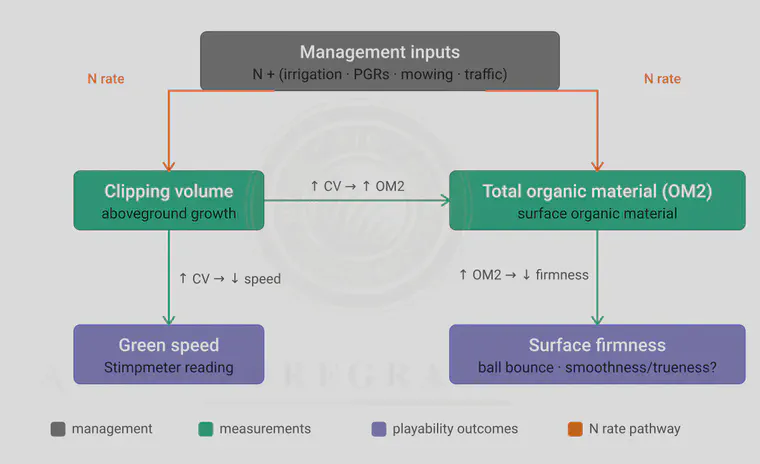
The clipping volume is related to the green speed. Greens with more clippings have a slower green speed.
The OM2 is related to surface firmness. Greens with lower OM2 are firmer.
The clipping volume is related to the OM2. Greens with more clipping volume have higher OM2.
The accumulation rate of OM2 is related to the N application rate.
None of this is a surprise. But realizing that this is the case, and then doing something about it, that turns out to be a remarkably useful management system.
When you know the N rate and the sand application rate, when you measure the clipping volume and the green speed and the firmness and the OM2, you’ll see these relationships. You can then adjust the management to move the green speed and the firmness in the direction you want them to go. And when you make multiple measurements across the property, as I encourage everyone to do, you can assess the consistency across the property. Now you are able to make adjustments not only in managing the surface performance within a desired range, but you’ll also have opportunities to make the surfaces more consistent across the property.
The connections go something like this.