Rootzone volume and P
When the soil doesn’t have much phosphorus, establishing grass almost always responds to the application of P fertilizer.
When the soil doesn’t have much phosphorus, established grass often performs perfectly fine without the addition of any P fertilizer.
I was reminded of this while growing in a new lawn in southern Thailand.
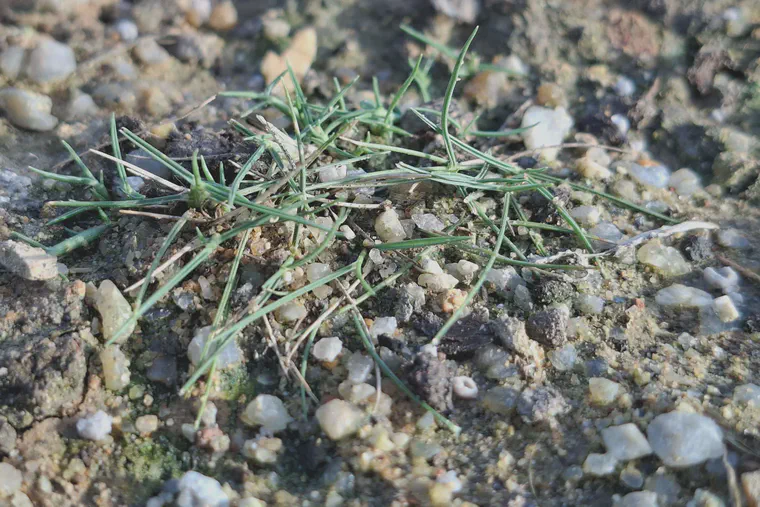
I applied P fertilizer soon after planting, and made another application of NPK fertilizer today.
Newly planted grass, whether that is from seeds, rhizomes, stolons, or sod, starts off without much of a root system. Let’s call it no root system—the newly planted grass has a rootzone that explores a soil volume of zero.
Now let’s think about the soil volume explored by an established sward. With roots 10 cm (4 inches) deep, roots in 1 m2 would be exploring a soil volume of 100 L (26 gallons). Or 1,000 ft2 (92.9 m2) of turf would be exploring a soil volume of 2,454 gallons (9,290 L).
Just-planted turf with no root system, and with P being relatively immobile in soil, needs P to be right where the roots are. Established turf can get away with much lower P throughout the rootzone, because established turf is exploring a comparatively huge volume of soil from which the P can be acquired.