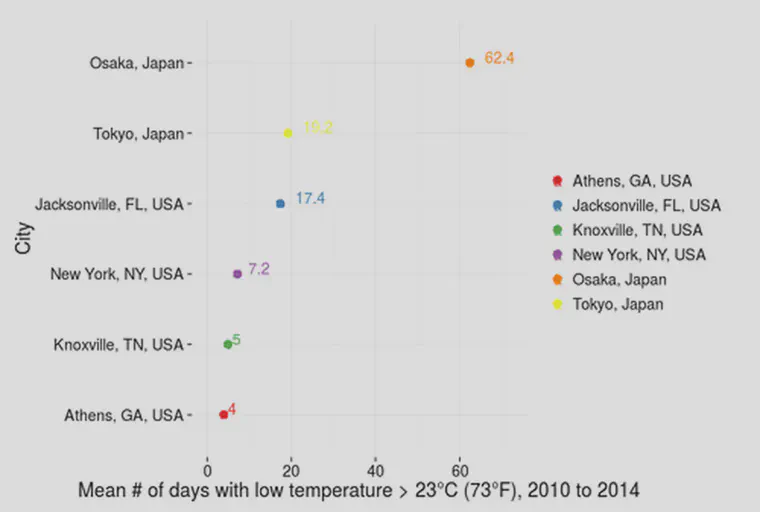
When is it too hot to grow bentgrass? A look at nighttime lows above x, y, and z
Last year I shared this chart and suggested that an average annual temperature can be a useful threshhold to look at.
If one looks at the locations with an average annual temperature less than 20°C (68°F), creeping bentgrass can generally survive. If one looks at locations with an average annual temperature more than 20°C, it would be rare (or impossible) to have creeping bentgrass turf.
Scott Griffith mentioned the importance of nighttime temperatures in creeping bentgrass performance during hot weather.
The nighttime temperatures, and especially nighttime soil temperatures, are critical to the maintenance of creeping bentgrass quality in high temperatures. This paper by Huang et al. explores what happens at different temperatures and identifies 23°C (73°F) as a critical temperature above which the “growth and physiological activities of both roots and shoots of creeping bentgrass declined.” Any increase in soil temperatures above 20°C (68°F) caused a decline in roots.
The night time low is important because that sets a minimum on what the soil temperature can be. There is no way the soil temperature will drop below the night time low temperature. So by looking at the night time low, as Scott described, one can estimate how much stress the bentgrass will be under.
I obtained daily temperature records from the past 5 years for these cities:
- Athens, GA, USA
- Jacksonville, FL, USA
- Knoxville, TN, USA
- New York, NY, USA
- Osaka, Japan
- Portland, OR, USA (but I’ve omitted Portland from these charts because the temperatures are just so low — only a few days each year above 18°C)
- Tokyo, Japan
The scripts to download the data and generate these charts are shared in this GitHub repository. The code could easily be modified to obtain data from any airport location of interest.
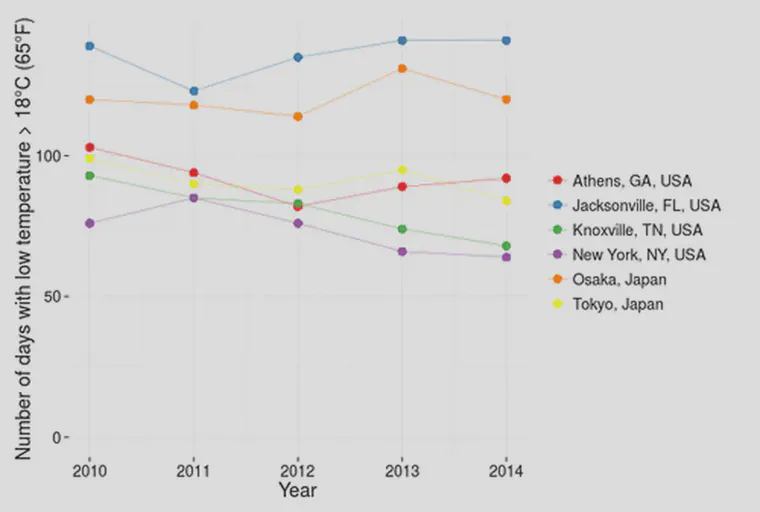
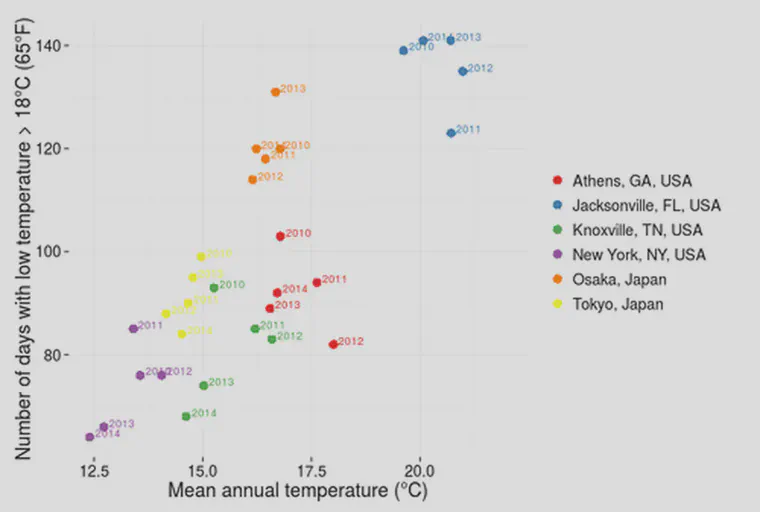
After getting the data, I first counted how many days with nighttime lows above 65°F (18°C) occurred in each of the past 5 years.
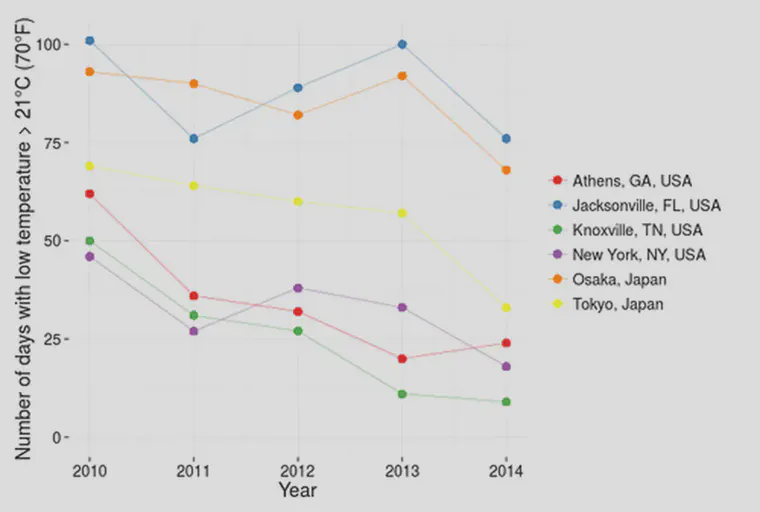
Scott mentioned that one really starts to see a difference in creeping bentgrass performance when the nighttime lows exceed 70°F (21°C) consistently. I plotted those counts for these same cities.
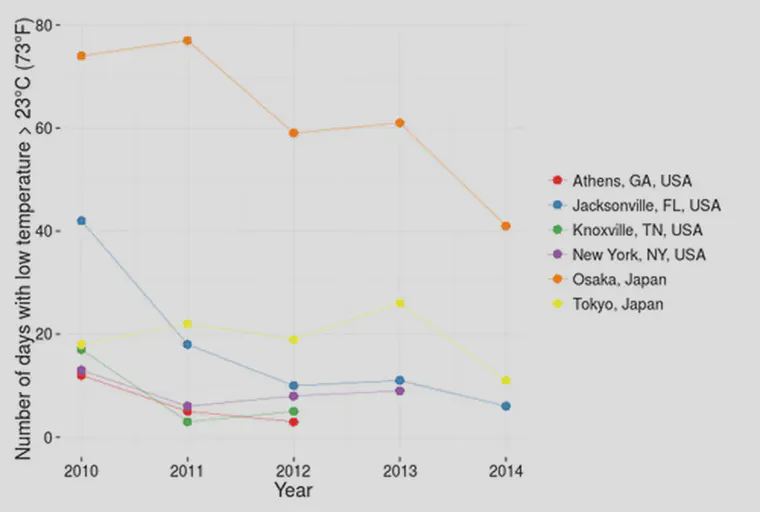
It is remarkable to see the number of days with a low temperature remaining above 23°C (73°F), which is an indication of extreme conditions for creeping bentgrass. Osaka has more than 60 days (2 months!) on average each year with temperatures above this critical level. And Tokyo has more days above this level in the past 5 years than does Jacksonville.
This shows average annual temperature plotted against the number of days above the 18°C (65°F) level. Jacksonville has an average annual temperature of about 20°C, and all the other cities have an average annual temperature less than 20°C. As far as I know, creeping bentgrass isn’t used in Jacksonville, but it is in the other cities.
Japan summers have really high low temperatures, and these mean values of days with low temperatures exceeding 23°C (73°F) over the past 5 years show just how many of those days there are.