Abstract
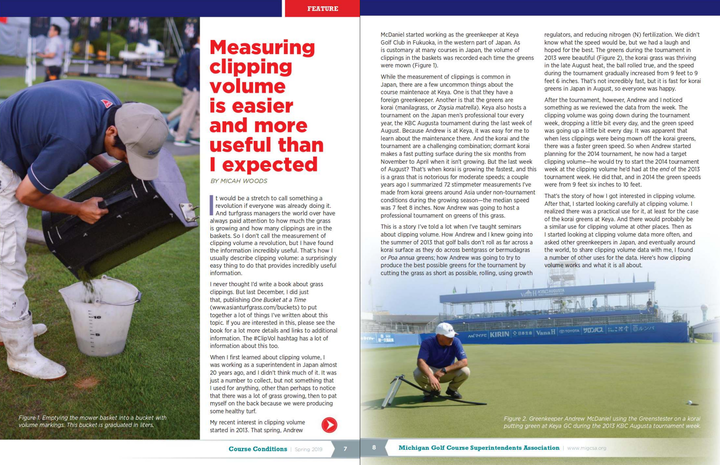
Turfgrass managers have always watched how much grass is in the mower baskets, but recording that amount as a number is less common. This article describes how measuring clipping volume turned out to be a surprisingly easy practice that yields very useful information. Interest began in 2013 at Keya Golf Club in Fukuoka, Japan, where clipping volume data from the korai (Zoysia matrella) greens during the KBC Augusta tournament showed that green speed rose as clipping volume fell. The following year, a target clipping volume was used to prepare the greens for the tournament. The standard procedure is to empty the baskets into a graduated container, settle the clippings, and record the volume. Results are reported in mL/m², a unit that avoids decimals and allows comparison across sites. Applications include detecting differences between mowers and between greens, managing for predictable green speed, describing turfgrass growth rate (which is central to greenkeeping), estimating nutrient use for an optimum nutrient supply in conjunction with MLSN, and reducing unnecessary growth to save resources while producing better playing surfaces.