Composite soil sampling for turfgrass
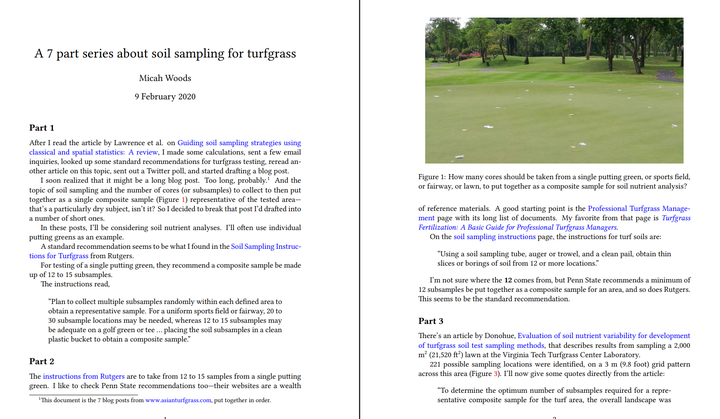
Abstract
Standard recommendations from Rutgers and Penn State call for at least 12 cores to be combined into a composite soil sample for an area the size of a putting green, and Donohue’s intensive sampling of a 2,000 m² lawn in Virginia led to a recommendation of 20 subsamples per 1,000 to 2,000 m². A Twitter poll of 182 respondents found that most turfgrass managers collect 6 or more subsamples per green. A review by Lawrence et al., however, argues that soil samples should not be composited at all, because nutrient concentrations are often lognormally distributed and composites tend to overestimate them. This seven-part series, compiled from blog posts, reviews these recommendations and then tests them with data. Thirty cores were collected from a 1,092 m² double green in Bangkok and analyzed individually with Mehlich 3. Composite sampling was simulated by drawing 1 to 30 cores at random, 200 times each, and calculating the geometric mean. With 6 cores (about 0.55 cores per 100 m²), the simulated mean was within 10% of the true mean more than 90% of the time for P, K, and S, with fewer cores required for Ca and Mg. These results suggest that a few subsamples per green are probably enough, that the standard recommendation of 12 or more is excessive, and that testing individual cores may be a better approach than compositing, though variability on more greens should be checked.