Playing with numbers, evapotranspiration edition
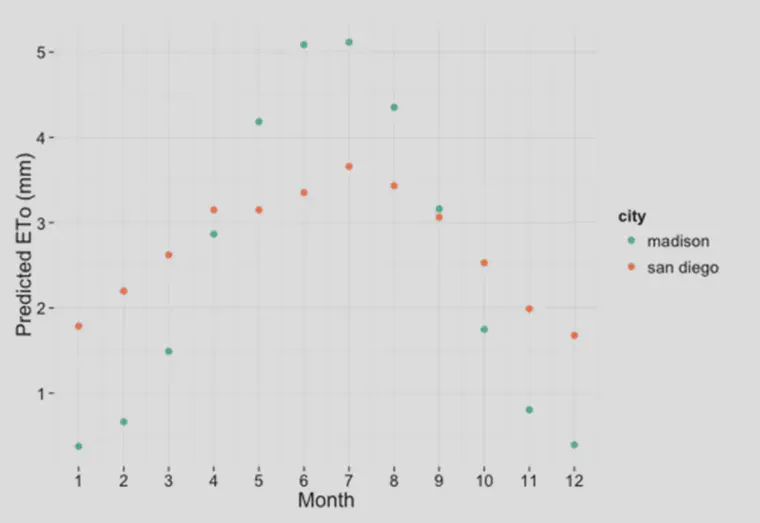
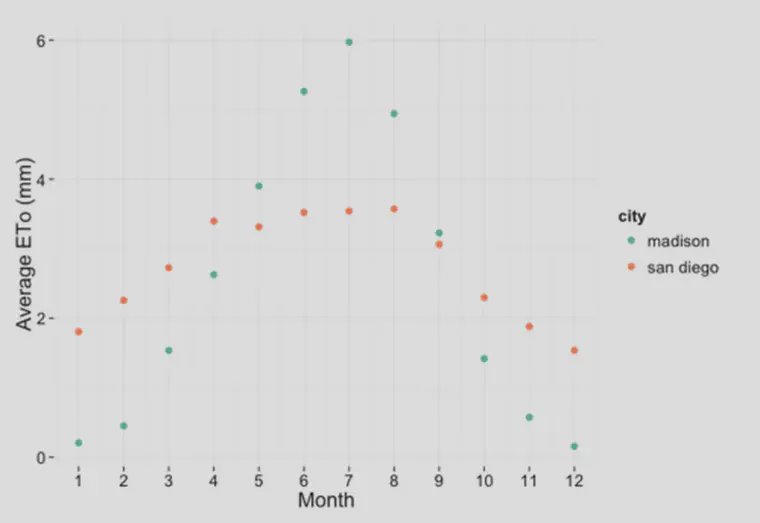
I’ve used equation 52 in Crop Evapotranspiration: Guidelines for computing crop water requirements (FAO Irrigation and Drainage Paper 56) to calculate the predicted ETo for San Digeo, California, and for Madison, Wisconsin.
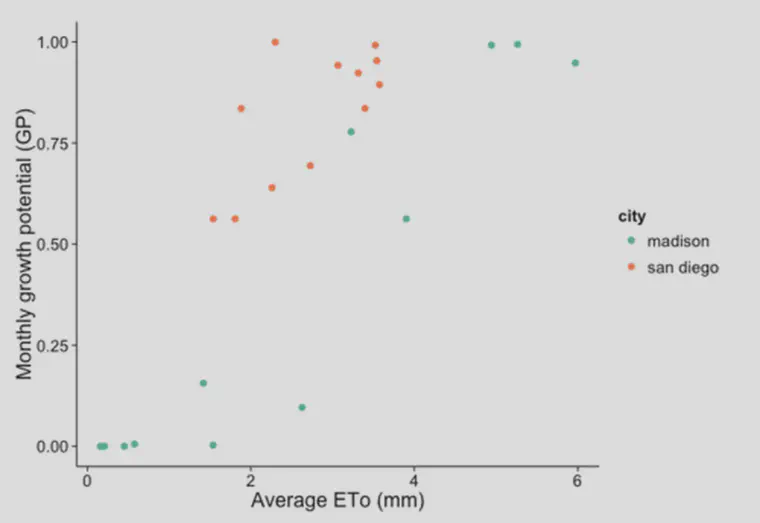
[][3]{.asset-img-link}But there is not such a close relationship between the temperature-based growth potential of PACE Turf and the ETo.
The ET is one way to look at nutrient uptake and nutrient demand. And it is important to remember that nutrients do go into the roots with water, so there is going to be a huge, dominating role of consumptive water use (ET) in how much of each nutrient gets used by the grass.
Even so, I think the GP is more useful as a predictor of nutrient requirement extended across grass species and locations. These calculations don’t show the whole story, but they are a first step at looking into this. And, it is interesting to see just how well equation 52, which requires only temperature and latitude data, predicts the average ET.