Ten Years Ago on a Golf Course in Japan: part 3
If you’ve flown into Narita Airport in Chiba prefecture near Tokyo, and have happened to look out the window, you may have been surprised when you flew over golf course after golf course as the plane descended. Chiba prefecture has more than 150 golf courses, placing it third among Japanese prefectures in golf course count. Only massive Hokkaido in the north, and Hyogo prefecture near Osaka, have more courses.
This map shows a portion of Chiba prefecture where there is an especially high concentration of golf courses. The satellite image was taken in the winter, so we see that the korai (Zoysia matrella) fairways and noshiba (Zoysia japonica) roughs are dormant.
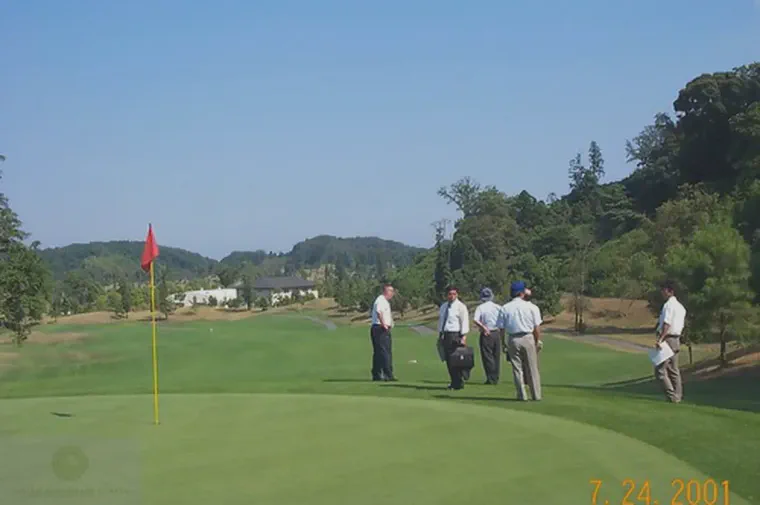
Many of the golf courses at Chiba were constructed in the golf course building boom of the early 1990's, and for these courses, there is a pesticide ban. I was a superintendent in 2000 and 2001 at Habu CC, which opened in 1996 and was thus subject to the pesticide ban. Here the inspection team from the prefectural government made a visit to inspect the course, the maintenance building, and our records. We could use wetting agents, Polyoxin-D, and phosphites; other than that there was very little in the way of chemical control products that we could use.
One thing that I focused on, with the limited resources we had to maintain the course, was to have the central playing corridors in as good a condition as possible. We tried to have perfect greens, tees and fairways as good as they could be, and less attention was paid to the roughs, particularly in out-of-play areas. You can see here, in a view from behind the 14th hole at Habu CC, that there are some weeds growing behind the green on this par 5.
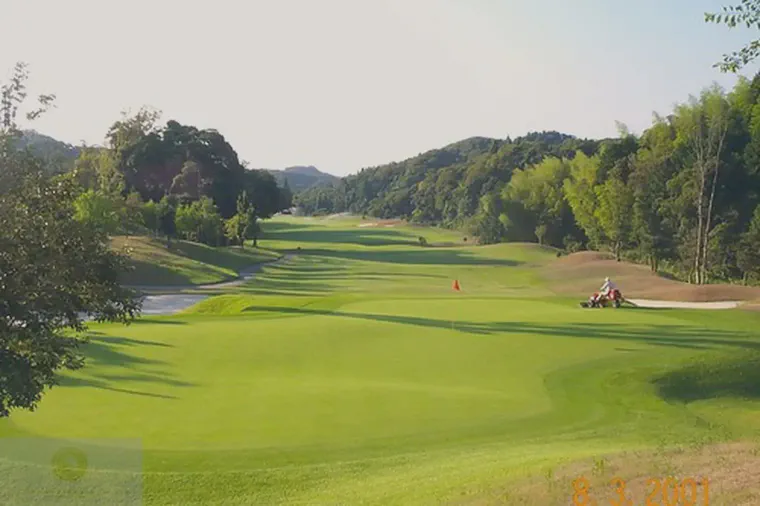
I’ve sometimes had long discussions with Japanese greenkeepers about the philosphy of balance in golf course maintenance. If resources for maintenance are limiting, I’ve always strived to make green perfect and the playing corridors as good as possible. In Japan, there has historically been the idea that there should be balance on a course, and that all of the areas should be maintained.
Balance is alright if you have enough resources to maintain every square meter at a high level, but if those resources are not there, then striving for balance is a sure way to have mediocre conditions all over the course. I think every course has the resources to make their greens perfect, and I am fine to let some out-of-play areas be a little less-maintained if I can ensure the greens will be excellent. This is still a challenge in Japan, because many courses were built in mountainous areas in a bubble economy and are inherently expensive to maintain. Maintenance budgets then get cut again and again, and it is very difficult to maintain these courses with the desired balance. I was lucky in my work, to be a foreigner, and to have an American boss. In this situation it was easier, culturally, to focus our maintenance efforts on the playing corridors.